

NC State Equine Surgeon Wins National Research Award for Work on Colic
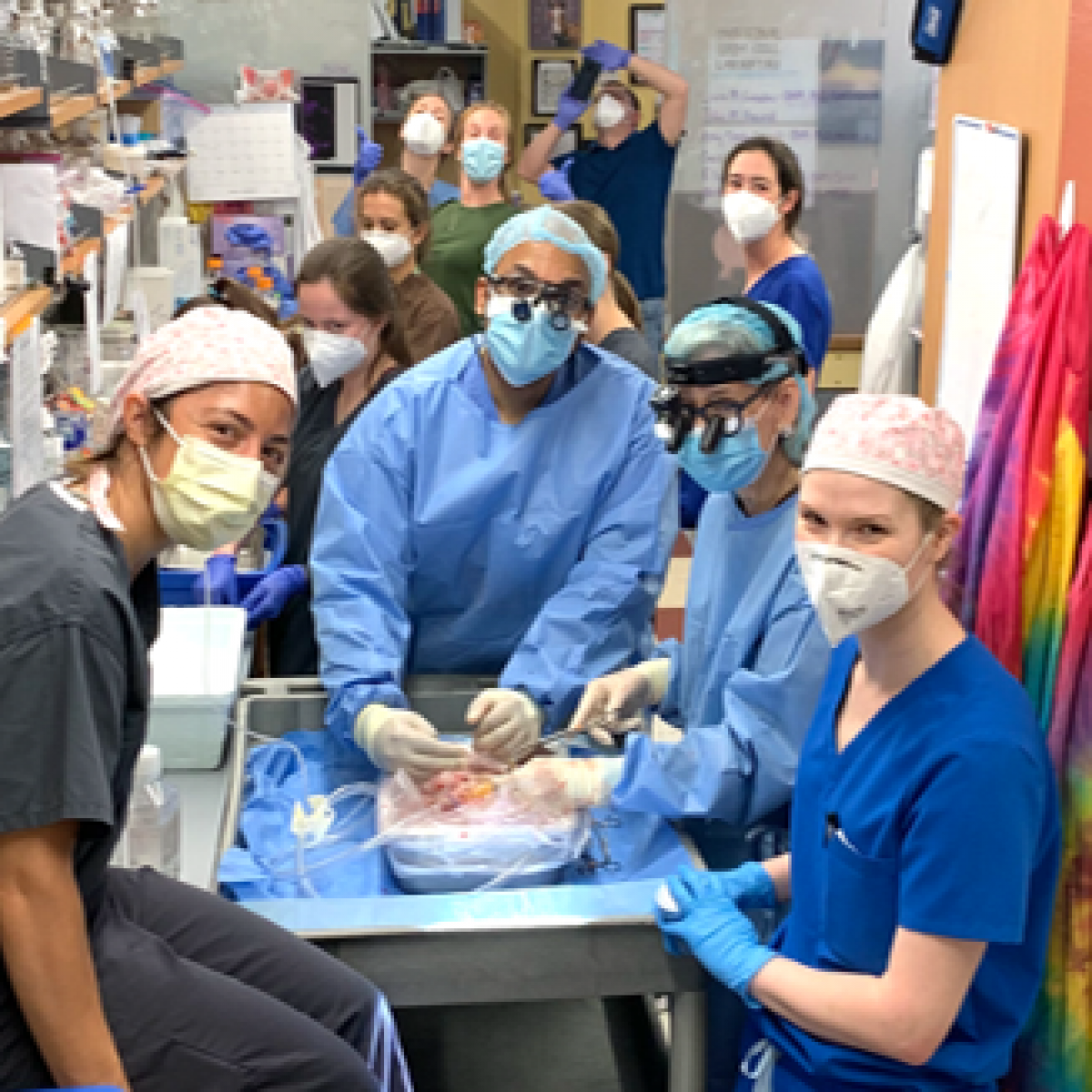
Dr. Liara Gonzalez, professor of gastroenterology and equine surgery at the NC State College of Veterinary Medicine, has won the 2025 American Association of Equine Practitioners Research Award for her innovative work with intestinal stem cells to advance the understanding and treatment of equine colic.
The award was announced today at the annual AAEP convention in Denver.
“I am so flattered and full of appreciation for receiving the award but also for being nominated in the first place,” Gonzalez says. “I think sometimes we’re just trying to get from Point A to Point B, and we forget that we have this impact on other people, on trainees, the graduate students, the residents, the veterinary students, so to have this type of reminder is really quite special.”
The Gonzalez lab was the first to home in on studying intestinal stem cells in horses and to develop a porcine model to study them. The researchers have been able to expand the cells into 3-D structures, called “mini guts,” and use the model to help improve the effectiveness of intestinal transplants in humans.
“Through her groundbreaking work profiling and developing tools to study the equine intestinal epithelial stem cell niche, Dr. Gonzalez laid the groundwork for in vitro modeling of the equine epithelium,” said Dr. Caroline McKinney-Aguirre, a research assistant professor at NC State, in her letter nominating Gonzalez for the award. “The establishment of equine ‘mini guts’ has allowed many other researchers to study specific injuries, pathogens and therapeutics in the intestine.”
In 2024, Gonzalez won a $3.5 million grant from the National Institutes of Health for a five-year project to study whether transplantable organs, which are traditionally preserved in static cold storage, stay healthier using normothermic machine perfusion or NMP. The technology has shown decreased rates of organ damage and increased rates of graft survival and function in heart, kidney and liver transplants in humans.
In a prior study, Gonzalez and her team showed that, in addition to successfully storing porcine small intestines for a longer time than cold storage, NMP also seemed to heal sensitive intestinal tissue from damage sometimes sustained in the organ procurement process.
The work has led to the Gonzalez lab being able to maintain viable horse intestine with the NMP device outside of the body, creating an optimal study subject.
“The sky’s the limit with the type of insight and knowledge we could gain from using these technologies,” Gonzalez says. “We need more people studying colic so that we can come up with some real game-changers. We need to be able to give guidance to owners on whether to continue with surgery or not, guidance to surgeons as to whether intestines should be resected or not, and then ultimately we can improve our outcomes.”
Gonzalez, who received her veterinary degree from Cornell University in 2006, completed a large animal surgery residency at NC State in 2010 and went on to two two-year NIH postdoctoral fellowships. She joined the NC State faculty in 2014. She is a co-director of the Large Animal Models Core for the Center for Gastrointestinal and Biological Disease, a partnership among NC State, the University of North Carolina at Chapel Hill and Duke University.
We asked her more about her path to being recognized with the 2025 American Association of Equine Practitioners Research Award.
Q: How did you become so interested in equine colic?
Dr. Liara Gonzalez: After my DVM, I went into a private equine practice internship in Patterson, New York, that was extremely influential in shaping me as a clinician. During my internship, I gained experience managing cases of colic and saw the opportunity to make a difference for horse patients and their owners. There can be so many emotional extremes when managing colic cases because these are the cases that can be the hardest to predict the outcomes. It’s when the horses and the owners are most vulnerable. When you win, when you save a horse from a severe type of colic, to me, it feels like an amazing accomplishment. During my residency is where it struck me, the type of impact you can have, what it means to not only save a horse’s life but what it means to the owners.
Q: Most of your research has ended up being translational in nature, helping humans as well.
Gonzalez: What the translational, NIH-type research has allowed me to do is really push the envelope on the level and the type of research I’m able to do in the horse. Many of the major advances that I, with the help of an amazing team of people, have managed to make with colic have started with the basic science, NIH-funded, human-related work. We developed the tools and the approaches, and then once they were established, we tried them with horse-derived tissue samples. Now we’re moving to intact horse intestine that we’re able to maintain ex vivo, outside of the body, and that was all derived from our work trying to improve the outcome of intestinal transplantation for people.
Well, now we have a more complex system where we can actually maintain a length of the horse’s intestine outside the body. With this system, we can induce injury on a larger, more physiologic scale by reducing the oxygen in the blood. We could cut off the blood supply all together or specifically obstruct the venous outflow. We could put toxins in the system. We can really re-create some of the key forms of intestinal injury that cause colic, and now we can actually put the therapeutics into the vasculature or into the lumen of the intestine, the inside of the intestine, and then sample it real time to determine if we see healing. We can evaluate how the intestine responds to those therapies.
Q: What do you consider your biggest breakthrough?
Gonzalez: Advancing the study of intestinal stem cells, both with regard to establishing their amazing capacity to repair intestinal damage and developing the technologies and the techniques to better study them. If we can better study the intestine, we can better understand what is causing the colic, and we can test therapies in a controlled way.
At this point, we’ve got the spectrum. We have single horse cells that we can establish and grow into more complex forms within dishes — there are advantages to studying horse tissue at that level — all the way to the most complex, but still outside the horse. With ex vivo machine perfusion, we’ve got all the layers of a length of horse intestine that we can study. We can evaluate motility. We can evaluate appearance. We can biopsy it. We can evaluate the venous blood that comes out.
Q: Has your work led to any therapeutics for equine colic?
Gonzalez: What we’ve accomplished is a better understanding of what’s happening. I would say we’ve got the tools to better test therapeutics. Before, when we have tried different therapeutics, they’re in settings that aren’t controlled, every horse has a different way that it’s been kept or maintained and different durations of colic. When we try and put these clinical studies together, they’re inevitably fraught with a lot of variability, and it’s hard to then say, “Did the treatment help or did it not help?”
With the in vitro assays that have been developed in my lab, the 2-D and 3-D stem cell cultures and now this ex vivo NMP device, we can control all of that. When we have more control over how we induce the injury and the extent of injury, we’ll be able to say, yes, this therapy did or did not work. We’ve made multiple advances with regard to diagnostics and determining tissue viability with all of my stem cell work, but we’re on the cusp of really being able to delve deeply into evaluating therapeutics and their effectiveness of treating colic.
Q: When you say “induce injury,” what do you mean?
Gonzalez: In our in vitro work, where we have the 3-D stem cell culture, or the 2-D, we can induce injury to horse cells. We can cut off the oxygen, or we could apply a toxin, or a variety of things that re-create the injury. It’s a more simplified version when you’re working in a dish or these in vitro cultures. If the treatment appears to help, then you go to a more complex system.
Q: You’re very animated about your work.
Gonzalez: The intestine is amazing. It’s such an important organ, and yet it is so sensitive. It has a single layer of cells that separates the very noxious content of the inside, which is normal — our intestinal tracts are filled with bacteria, all kinds of things that should not have access to our bloodstream — but there’s only a single layer of epithelial cells that separates the luminal contents from accessing our systemic circulation.
The intestine is not a privileged organ, so anytime there’s a decrease of blood — the horse is stressed, or the horse is exercising intensely — other organs like the heart and the brain and major muscles, the blood gets shunted to those organs and away from the intestine. When that oxygen gets shunted away from the intestine, that single layer of cells actually is the first to die, and when it dies, those toxins and potentially damaging substances in our intestinal lumen have access to our bloodstream.
The good news is that the intestine has this incredible capacity to repair, and that’s really where my research has come in, through leveraging the intestine’s natural capacity. Intestinal stem cells that are part of that single layer are actively turning over and creating new cells on a 24-hour basis, so basically we have an almost brand new lining of the intestine about every week or so.
If we can understand how to target those cells, we can leverage this amazing capacity to help it repair faster, more efficiently and better, so that the intestine can get back to its job of creating this very complex barrier that both prevents noxious things from passing through as well as absorbs nutrients and water. This is especially critical for colic because we can’t prevent most of it, despite the best care possible, and so these new therapies are needed. I am passionate about research and this work because it has the potential to have a significant positive impact on horses and owners’ lives.
Author: Burgetta Eplin Wheeler
Source: https://news.cvm.ncsu.edu/
 Comments
Related Articles

More news




Copyright © 2026 - All Rights Reserved
ISSN 2768-198X
List
Add
Please enter a comment