

NC State Behavioral Specialist Gets $5.5 Million NIH Grant for Research Contributing to Opioid Fight
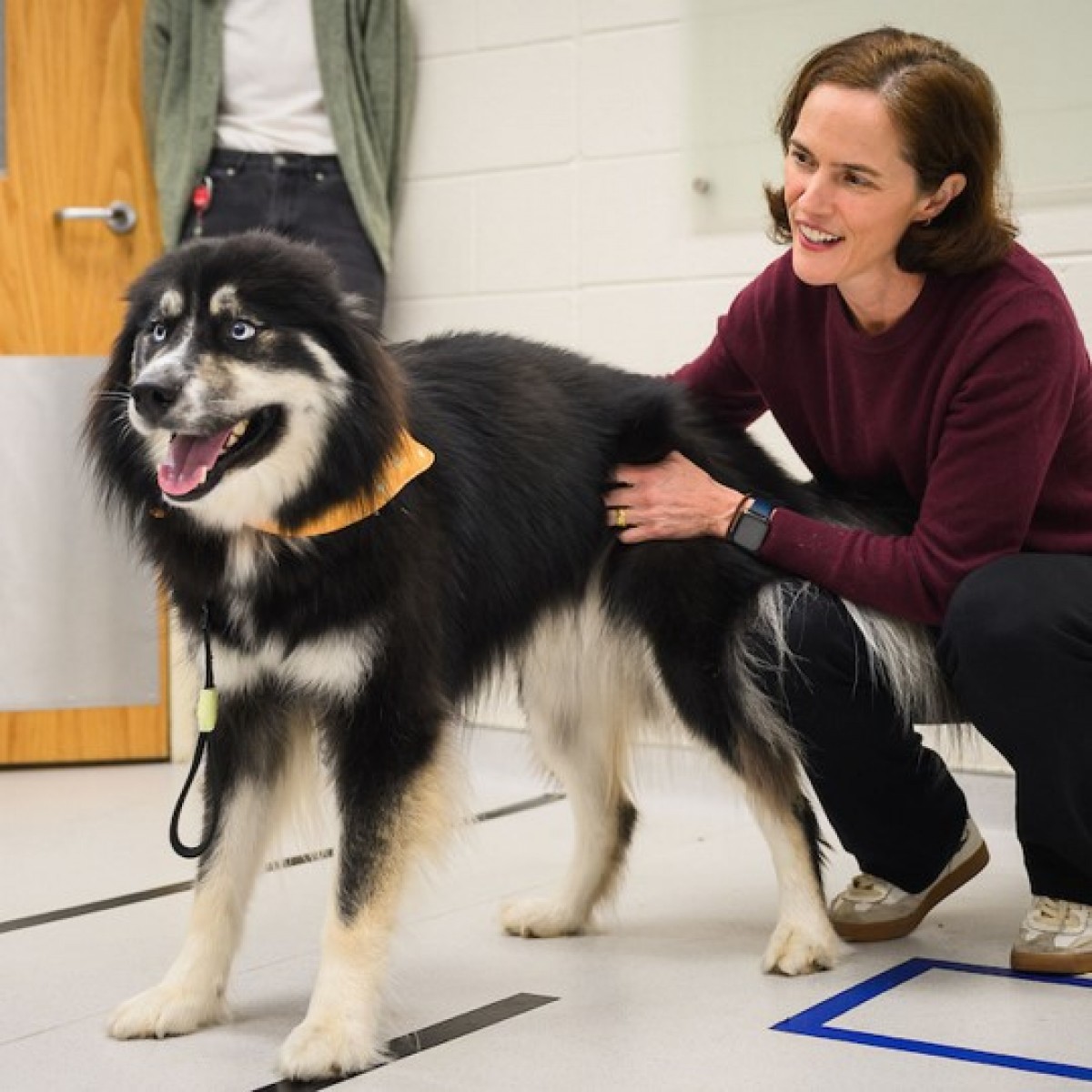
As part of its ongoing effort to combat opioid addiction in the United States, the National Institutes of Health is accelerating promising research into the mechanisms and fallout of pain, recently awarding a $5.5 million grant to Dr. Margaret Gruen, professor of behavioral medicine at the NC State College of Veterinary Medicine, to study ways to measure the effect chronic pain has on how dogs think and behave.
When the NIH issued a call for pain research that used nonrodent models, Gruen answered with a winning proposal to study dogs suffering from osteoarthritis. Gruen then assembled a dream team of Triangle experts to collaborate on the research, which is part of the NIH’s Helping to End Addiction Long-term Initiative, or HEAL, created as an all-hands-on-deck approach to addressing the opioid public health emergency.
“The NIH has put a lot of funding into trying to find alternatives to opioid medications and into just a better understanding of basic pain biology and the biopsychosocial components,” says Gruen, a board-certified veterinary behaviorist who has DVM and a Ph.D. “The way that people process or think about pain and the way pain makes people feel are an important part of treatment.”
Joining Gruen from NC State will be Dr. Duncan Lascelles, professor of small animal surgery and pain management, and Dr. Masataka Enomoto, a research associate in the Translational Research in Pain program that Lascelles leads. Dr. Brian Hare, professor of evolutionary anthropology at Duke University; Dr. Frank Keefe, director of the Duke Pain Prevention and Treatment Research Program; and Liubov Arbeeva, a biostatistician from the Thurston Arthritis Research Center at the UNC School of Medicine, will add their expertise to the project as well.
“Margaret’s ability to build a team and essentially convince the funding agencies that this is a reasonable and important translational piece of work is something we’re really proud of,” says Dr. Joshua Stern, associate dean of research and graduate studies at the NC State CVM. “We’re really excited for her. It’s so well-deserved.”
Where This Grant Comes In
Dogs are becoming a standard model for studies translatable to humans because they live in the same environments, often go to the same places and sometimes eat the same food as their owners. Lascelles has several grants for studies that include dogs as naturally occurring models for arthritis.
Gruen’s research will focus on capturing ways to measure how dogs with chronic pain behave.
“In people, the biopsychosocial model of chronic pain really takes into account the cognitive and the emotional pieces, not just the sensation of pain, but really understanding how pain makes people feel and how people process and understand pain,” Gruen says. “None of the animal models really do that.”
With dogs, owners will say, “He just seems really sad,” or “He doesn’t seem to enjoy doing the things he used to do,” or “He doesn’t greet me at the door anymore,” Gruen says.
“So we recognize it clinically, but we’ve had no way to measure it,” she says. “And that’s where this grant comes in.”
The project, which will run over five years, aims to develop a battery of tests that measure cognition, emotion and enjoyment of life and then to use a longitudinal study to assess the difference in results between dogs with chronic pain and those without. The last step will be comparing dogs with chronic pain that are being treated for their pain against untreated dogs to see how treatment might change their performance on the tests.
“That’s why having this outstanding biostatistician from UNC is so key,” Gruen says. “As we’re going through this, she will use the data and help us refine what tests need to be done.”
Some of the testing will be conducted at the Duke Canine Cognition Center, where Gruen worked as a post-doc with Hare on assessing cognition and cognitive functioning in dogs.
“We’ve been doing cognitive testing at NC State for a long time, but we decided to separate it because if we’re looking at dogs who have any fear of the vet hospital, we wanted the cognitive testing to be physically separate so that dogs don’t have any association with physical exams,” Gruen says.
Hare, who founded the Duke Canine Cognition Center in 2009, and wife Vanessa Woods are the authors of the New York Times best-selling book “The Genius of Dogs: How Dogs are Smarter Than You Think” and “Survival of the Friendliest: Understanding Our Origins and Rediscovering Our Common Humanity,” which was featured in a National Geographic video segment.
In addition, the project includes a team of postdoctoral researchers and study coordinators, who will juggle the complicated array of appointments, testing sessions and study visits. Several NC State and Duke undergraduates also have volunteered to participate in the research.
“It’s an incredible training opportunity as well,” Gruen says. “It’s truly interdisciplinary, and so we have postdocs with backgrounds in welfare, cognition and psychology and undergraduates across multiple majors.”
‘A Stealer of Attention’
The longitudinal study portion will require enrolling both healthy dogs and those with osteoarthritis, or OA, to take the battery of tests, tracking their activity for a month and then retesting them and comparing the results. The dogs with OA then will be divided into a treatment group and a placebo group for further assessment.
“In people, chronic pain is a real stealer of attention so tasks that require attention and focus and executive functioning are the ones that are affected,” Gruen says. “We would hope to see that when we treat dogs for pain, we see improvement in cognitive functioning, that we see more joy in life and that the emotional aspects would also improve with treatment for chronic pain.”
The project’s end result would be a naturally occurring animal model of chronic pain relevant to human conditions that will improve the translational potential for developing novel non-opioid pain therapies, Gruen says.
“This opens an opportunity when developing a treatment or a procedure that might be useful for people, as we will understand how that also affects cognition and emotional aspects because we’ll have the dogs as a model,” she says. “Dogs develop arthritis that’s really similar to people, so they have this opportunity to help us understand more about chronic pain in a way that helps the dogs, too.”
One test might be training a dog over a series of trials that one side of a room always has a treat and one side never has a treat, Gruen says. Most dogs will stop going to the side that has no treat. But what happens when a treat is placed in the middle of a room?
“What we found in some pilot data is that the dogs who have no pain, many of them will go check it out, because there’s very little cost to check it out,” she says. “But dogs with chronic pain, it might be painful to walk that far, and so they don’t or they go much more slowly. That kind of pessimistic bias is something that we hope to see shift.”
Gruen had seen the call for grant proposals earlier last year but was too busy to apply. When she saw the last round of asks go out last fall, she put together a proposal but felt she had little hope of success because NIH grant proposals usually require more than one round of revisions.
“It was kind of a long shot, because usually you get a grant back, and you revise it, and you put it in again, but this was it, the last chance we would have,” she says. “So it is pretty exciting. We have this incredible team, and it feels like it was meant to be.”
Author: Burgetta Eplin Wheeler
Source: https://news.cvm.ncsu.edu/
 Comments
Related Articles


More news






Copyright © 2026 - All Rights Reserved
ISSN 2768-198X
List
Add
Please enter a comment