

Undergrad researchers drive discovery in the College of Veterinary Medicine
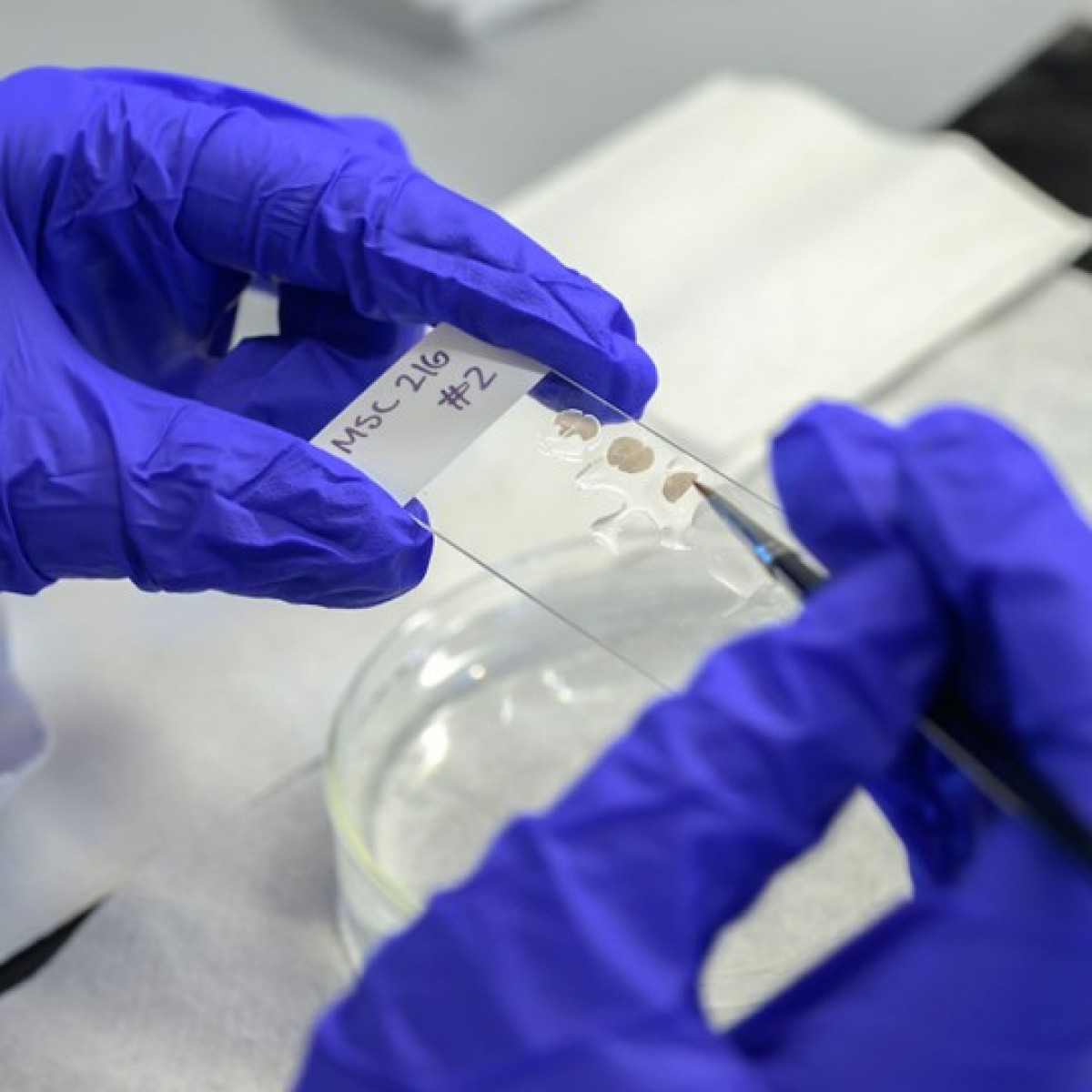
Undergraduate students in Washington State University’s College of Veterinary Medicine helped power the research behind a recent Nature publication that found humans share key skin structures linked to youthful skin with pigs and grizzly bears that form after birth.
The study is one example of how undergraduates are playing an increasingly central role in research across the college, taking on responsibilities often reserved for graduate students and contributing directly to major discoveries. Faculty like Ryan Driskell, whose Skin Regeneration Laboratory drove the Nature findings, have long embedded students in their work, a model now being expanded through the EschLEAD (Learn, Experience, Apply, Deliver) program, which immerses undergraduates from a wide range of backgrounds in hands-on research experiences.
“We want students to have real experiences, not just learn about science from a textbook,” said Driskell, an associate professor in the School of Molecular Biosciences. “That helps prepare them for what comes next in their careers, and it strengthens the research because they bring fresh ideas and energy into the lab.”
Driskell has been at the forefront of the college’s efforts to expand undergraduate research opportunities and played a key role in establishing EschLEAD, which was launched in 2024 through a gift from Robert Esch (’75 BS, ’78 MS) and Katherine Esch.
While Driskell was listed as the corresponding author and graduate student Sean Thompson as first author for the recent Nature publication, seven undergraduate students — including Natalie Williams and Corin Yanke — appeared alongside as co‑authors.
Williams joined the lab in 2021 as a microbiology major looking to gain research experience ahead of applying to medical school. Her work laid the scientific foundation for the Nature publication.
Driskell was interested in determining the development timing of rete ridges, microscopic structures that help skin maintain strength and elasticity. Long believed to form before birth, he suspected that assumption was incorrect. Pig skin, a well‑established model for human skin, offered a promising way to test the idea, but securing pigs at varying developmental stages would cost tens of thousands of dollars per time point.
Willliams proposed a different and much more economical approach — using preserved pigs commonly sold for around $10 for use in high school biology classes.
“Thanks to Natalie, we found a ‘scientific hack’ to what would normally be a very expensive problem,” Driskell said. “That allowed us to launch the project and ultimately led to the foundational discovery for this research.”
Using the low-cost specimens, Williams was able to generate professional-quality histological images key to establishing a detailed developmental profile of pig skin.
Ultimately, the lab demonstrated that rete ridges did not form during fetal development and instead appeared only after birth.
Now a third‑year medical student at WSU, Williams said the experience helped her grow well beyond technical skills.
“Professionally, I grew significantly,” she said. “I presented this research at conferences, traveled, networked and learned how to communicate science. I don’t think experiences like this are common at many universities, and it made a huge difference when I was interviewing for medical school.”
Yanke’s contributions were also critical to the study.
A biochemistry major who graduated in May 2024, Yanke joined the lab in November 2021, initially supporting the work through histological analysis, tissue processing and staining. Following a summer internship at Advanced Dermatology in Spokane, Driskell encouraged her to build on that experience and her new clinical connections to draft the lab’s Institutional Review Board protocol governing the ethical collection and use of donated human skin samples. The protocol was approved, allowing the lab to begin working directly with human tissue.
“Working directly with donated human skin and finalizing an IRB helped deepen my understanding of human research and further motivated me to pursue medicine,” Yanke said. “It was a unique opportunity that allowed me to gain advanced research experience, which I feel is not typically available at the undergraduate level.”
Yanke plans to begin medical school this fall.
Undergraduate impact extends beyond Driskell’s laboratory.
Cynthia Haseltine, an associate professor in the School of Molecular Biosciences, has entrusted undergraduates to assist in testing the effectiveness of an antimicrobial compound she developed against a range of pathogens, including those responsible for fire blight in apples and Listeria on food packing lines.
“These students have been indispensable,” Haseltine said. “They bring an energy and enthusiasm that really drives the work forward. It’s obvious where the undergraduates are in labs — they’re excited about the science, and they deserve authentic laboratory experiences that go far beyond what you get in the classroom.”
The approach benefits both science and students.
“If students leave with a clearer sense of what they want to do, and we’ve advanced the science along the way,” Driskell said, “then that’s exactly what we should be doing as a university.”
Source: https://news.wsu.edu/
 Comments
Related Articles
.jpg)



More news



Copyright © 2026 - All Rights Reserved
ISSN 2768-198X
List
Add
Please enter a comment