

The future of veterinary care
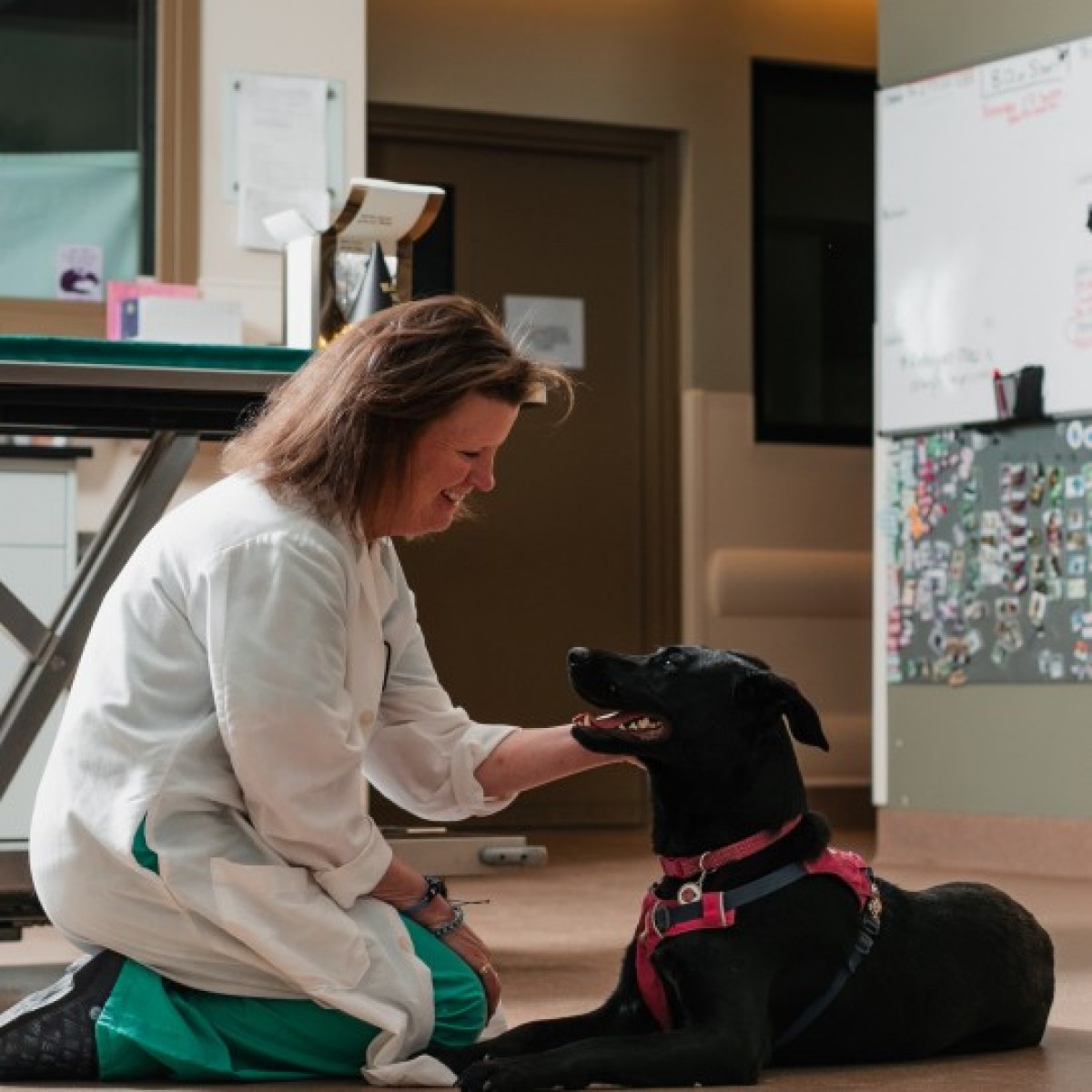
Colorado State University is transforming the future of veterinary medicine with a cutting-edge project designed to modernize the way clients and patients experience veterinary clinical care at CSU. Situated on the University’s South Campus, the new Veterinary Hospital and Education Complex, or VHEC, includes an expanded, state-of-the-art veterinary hospital that will greatly enhance animal care, benefiting new generations of veterinarians and pet owners.
For CSU faculty and staff, there’s plenty to be excited about when the expanded facility – a 213,000-square-foot building connected to CSU’s existing veterinary hospital – opens this summer. Ask Dr. Kelly Hall, medical director for small animal specialty services, and she’ll enthusiastically deliver what might sound like an unconventional answer: the new front lobby.
“There are so many cool things happening with this project, and the lobby I’m especially excited about,” Hall said. “First impressions matter, and a lot of thought has gone into this from a patient and client perspective; I’m eager for people to experience that.”
Clients who bring their animals in for care will immediately get a sense for why Hall is so pumped about an entryway. It starts outside, with three new entrances to the hospital – primary care, emergency care, and small animal specialty services – that will guide patients into a large, open intake area that’s intentionally designed to reduce stress on animals. There are shelves to place cat carriers up off the floor, away from curious pups, as well as dividers that help keep dogs separated while their owners check in. There are also species-specific waiting rooms for cats, dogs, and exotic animals. Even the paint color on the walls – soft grays and blues – was selected specifically to help reduce animal stress. (Bright whites and vibrant reds and oranges can be bothersome to dogs.)
“We’re going to be able to provide our clients with a much more modern experience throughout the hospital and that starts with an expansive check-in area,” said Dr. Chad Johannes, executive director of the veterinary hospital. “There can be a lot of anxiety coming to a hospital for both pets and pet parents; the way we’ve set up this new building is going to hopefully help ease some of that stress.”
World-class faculty and facilities
CSU’s existing veterinary hospital was constructed more than 50 years ago, in the 1970s. The new complex, Johannes said, will set the standard for CSU veterinary medicine and care for the next 50 years, matching the high standard of care that CSU faculty and staff already provide patients. The ambitious project also includes innovative enhancements to the University’s Doctor of Veterinary Medicine curriculum.
“We have world-renowned people across our hospital and technicians who are doing amazing things,” Johannes said. “Now, our brilliant faculty and staff will have the facilities to do what they have always done but even better. This is really going to give our clients the experience they deserve.”
Sheila McMullan, senior associate dean for CSU’s Veterinary Health System, also sees the complex as an opportunity to make a new first impression on both the local community and clients who travel from all over the country.
“We want this hospital to be a point of pride for our community,” McMullan said. “We have clients from all over the country who bring their animals here because we offer exceptional care. Now, people are going to see a better visual representation of the quality work we do; I think that’s really important.”
Multiple clinical care teams will be housed in the new building when it opens this summer, including emergency, critical care, dentistry, ophthalmology, pharmacy services, and a significantly expanded primary care service. About 70% of CSU’s D.V.M graduates go on to work in primary care, and students will now spend a minimum of 14 weeks on primary care clinical practice, up from a total of four weeks.
Karissa Ochs, a supervisor in the hospital’s Emergency and Critical Care service, said the new building will help smooth out some of the limitations her team experiences in the existing facility. For instance, she said, spaces for dogs staying overnight will now each have individual lights so a veterinary technician can more easily check on a single patient at night without disrupting other dogs that may be sleeping; there will be better visibility and lines of site across large emergency rooms so it’s easier for staff to keep an eye on patients in critical situations; and there are open, quiet areas attached to emergency care rooms where clients can have a private moment with a pet that is critically ill.
“We’re able to do a good job now – but it’s going to make things easier to have some of these options in the new building,” said Ochs, who has been consulting regularly with the building designers to look for ways to improve care delivery. “I’m really glad we’ll have these private spaces near the treatment rooms because we’ll be able to give clients a more protected spot to be with their family members.”
There are other changes to emergency and critical care operations that Dr. Hall, who works closely with those teams, is excited about. The new building has dedicated entrances that lead directly to isolation spaces for animals with infectious diseases, rather than those animals having to enter the hospital through the emergency entrance. Even a seemingly smaller detail like the location of the pharmacy – an easily accessible spot near the front entrance – will help improve client and staff flow throughout the building, Hall said.
“There are amazing things that happen in our hospital right now, all the time.” Hall said. “I think this new building is going to better reflect that.”
Taking care of hospital staff
In addition to the new building being constructed with pets and clients in mind, it was also designed to better support the clinicians who care for the animals in need of treatment.
“We have a lot of great people who do a lot of really difficult things – making sure those team members are being taken care of from a mental and physical wellness standpoint is important,” Hall said.
The building was designed to maximize natural light throughout. There are multiple spaces – indoors, outdoors, communal, and private – for staff to take a break. There are quiet resting areas, showers, and a convenience store on site that has food options. These details and others have made the building a candidate for certification under the WELL Building Standard, a healthy building certification program that emphasizes the importance of concepts such as ease of movement and access to fresh air, natural light, nutrition, and community. If successful, VHEC will be the first WELL-certified veterinary hospital in the country.
“Our philosophy here is patient first,” Hall said. “But it’s also a big part of my job to take care of our teams so they can take care of our patients – and this building is going to be a great space for our people.”
Making sure the hospital staff are cared for is something Sam Gould, a veterinary technician who manages the emergency and critical care teams, has been thinking about since she rejoined the hospital in 2023.
“The goal is to elevate patient care and have team members who are happy with their jobs,” Gould said. “Expanding into this new building is going to help us continue to improve on that.”
Everything from having standardized equipment throughout the building to improve efficiency to dedicated lockers and lunch spaces will help with this goal, Gould said.
“My belief,” Gould said, “is that if I can help advocate for the team, then they can worry a little less about having to advocate for themselves and they can focus on what they’re best at: taking care of patients.”
The $230 million VHEC construction project is the first part of a multiphase master plan. Future phases will focus more on existing spaces, including a full renovation and expansion of CSU’s small animal specialty hospital that will employ a similar approach: creating spaces that help enable all clinical staff and students to care for patients.
College of Veterinary Medicine and Biomedical Sciences
Improving the health of animals, people and the planet has been central to CSU’s land-grant mission since its founding, and that vision remains at the heart of the College of Veterinary Medicine and Biomedical Sciences today. The College offers bachelor’s degrees in biomedical sciences and neuroscience and has a robust graduate student program, which includes the renowned Doctor of Veterinary Medicine program. CVMBS faculty explore a variety of pivotal issues in infectious disease, orthopedics, neuroscience, cancer biology, animal reproduction and translational medicine.
Author: Christopher Outcalt
Source: https://cvmbs.source.colostate.edu/
 Comments
Related Articles


More news





Copyright © 2026 - All Rights Reserved
ISSN 2768-198X
List
Add
Please enter a comment