

The Cat that Always Lands on His Feet at Foster Hospital
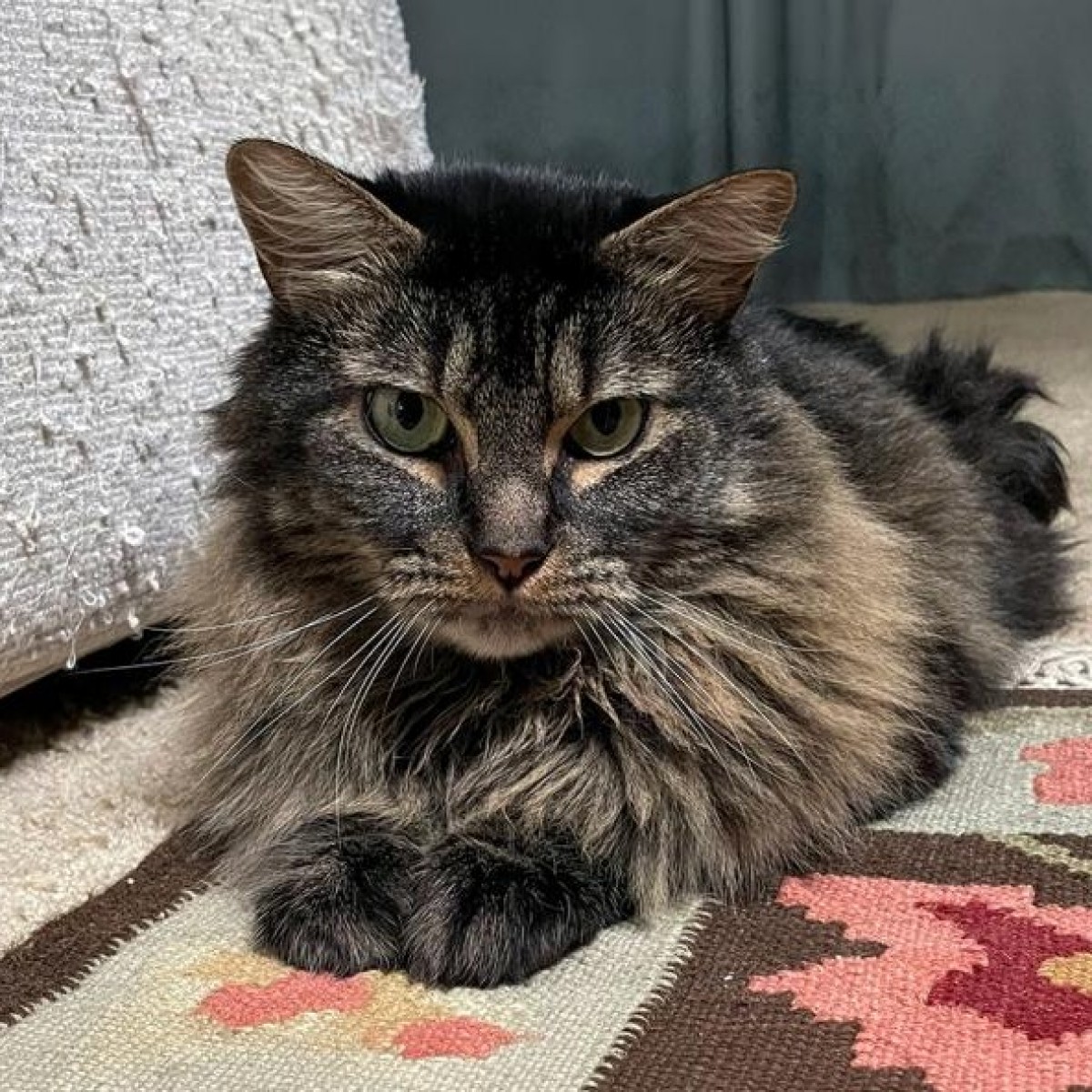
A resilient rescue cat named Corduroy is by now a familiar face at Henry and Lois Foster Hospital for Small Animals (FHSA) at Cummings School of Veterinary Medicine at Tufts University. The Oncology, Emergency Medicine and Critical Care (ECC), Internal Medicine, Diagnostic Imaging, and Dermatology teams have worked closely together to treat his cancer, chronic diseases, and other conditions, while always prioritizing his quality of life.
Jennifer Andrews, A94, and her husband Leo, adopted Corduroy as a kitten from a shelter eleven years ago.
“We were waiting for him as much as he was waiting for us,” says Andrews. “When we brought him home, he was initially very skittish, but he's the sweetest, most loving cat. We adore him. I get home from work, and he runs to the door to greet me.”
Corduroy suffered a trauma before he was rescued. He is tiny, only six pounds, and has had a series of medical issues over his life, including a tilted gait, neurological and cardiac conditions, and a broken hip that required surgery. As a patient at FHSA, he has battled cancer and chronic conditions—and always bounces back.
In the fall of 2023, Andrews returned from work one day to find Corduroy curled up on the floor in the same spot she had left him that morning. Concerned, she brought him to a veterinary hospital, where a mass was found in his small intestine via ultrasound. Corduroy underwent intestinal resection surgery to remove the mass. A biopsy revealed that he had large cell gastrointestinal lymphoma, an aggressive form of cancer in the lymphocytes (white blood cells).
Corduroy was referred to the Harrington Oncology service at FHSA. The clinicians presented a few treatment options: a palliative approach, focusing on minimizing his symptoms with steroids; single-agent chemotherapy; or targeting the cancer cells with multiple types of chemotherapy, the most intensive of the options.
“The goal of chemotherapy is always to maintain a good quality of life, even while patients are on protocol. The goal was to make him feel as best as he possibly could while minimizing side effects,” says Dr. Caitlin Jozwiak, small animal medical oncology resident at FHSA.
The Andrewses opted for single-agent chemotherapy. Corduroy tolerated his four monthly treatments well.
Jozwiak explains that approximately one-third of feline large cell lymphoma patients don’t respond to treatment and survive one to three months. Roughly one-third make it through the protocol, but the disease progresses, and they survive another six to nine months. “About one-third of patients do really well, like Corduroy, where they respond beautifully to treatment and have a prolonged life of a year or more. His outcome is fantastic,” she says.
Corduroy’s cancer has remained in remission for two years. Though he has since developed other chronic issues. A few months after completing his cancer treatments, Corduroy returned to FHSA, this time to the emergency room, struggling to breathe. The ECC team treated him with oxygen and diagnosed feline asthma.
Not long after, during a cancer recheck at FHSA, Corduroy’s bloodwork showed high kidney values. The Oncology team referred him to FHSA’s Internal Medicine service. A kidney stone was found through diagnostic imaging, and after additional testing, Corduroy was also diagnosed with chronic kidney disease and chronic liver issues.
Dr. Sydney Swartz (she/her), resident in small animal internal medicine at FHSA, manages Corduroy’s care. “Corduroy is a sweet cat, easy to work with, and very much a fighter. My job for him is juggling a lot of different conditions and balancing that with his quality of life. There's a lot that I can offer for patients, but it's not always the right decision for an individual pet or owner. At this stage in his life and with how well he's been doing despite all these different things, Corduroy’s owners have expressed that their big goals right now are maintenance and his good quality of life, and not necessarily pursuing invasive treatments or diagnostics,” she says.
The Andrewses bring Corduroy to FHSA every three months for ultrasounds and bloodwork to monitor his conditions. Swartz confers with the Oncology service to wrap in any tests to ensure his cancer has not returned. He has since also developed itchy skin and bald patches, so she pulled in FHSA’s Dermatology service for consultation and recommendations to manage those issues.
On the crossover between services to treat patients like Corduroy, Swartz says, “Patients don't go into neat and tidy boxes of oncology patients, dermatology patients—they oftentimes have multiple conditions. I'm thankful that at Tufts, there is this culture of walking down the hall to chat with another team about management of these complex patients that need a little bit of help from everyone.”
Dr. Michael Stone, associate clinical professor in the Department of Small Animal Clinical Sciences at Cummings School and from the Internal Medicine team, also helped treat Corduroy. “After more than 25 years at Cummings School, what continues to inspire me is the culture of collaboration here. Corduroy's care across Oncology, Internal Medicine, Dermatology, and Emergency Medicine is a perfect example—no single service could have managed all of that alone. Being able to draw on expertise from different services, having multiple sets of eyes on the patient—that's something I truly love about being part of this community.”
From the pet owner’s perspective, Andrews adds, “Corduroy is seen by so many specialists. I appreciate the comprehensive care. Dr. Swartz has been so wonderful, compassionate, and honest. She will sit and talk with us for as long as we need. All the doctors, students, medical assistants, and desk folks are so friendly and understanding. For a place where you can see a lot of sadness, it's been a place for us of consolation and happiness and hope.”
As an alumna, Andrews donates monthly to Tufts. After Corduroy’s experience at FHSA, she increased her monthly donation and directed half to Cummings School.
“It's important for us to express our gratitude through philanthropy,” Andrews says. “Our hope is that it helps other people who maybe can't afford their vet bills, or a vet student with financial aid, or maybe it's research. Corduroy is just everything, and the fact that we've been able to get an extra two and a half years with him has really enhanced our lives, so we're incredibly grateful.”
Source: https://vet.tufts.edu/
 Comments
Related Articles


More news


Copyright © 2026 - All Rights Reserved
ISSN 2768-198X
List
Add
Please enter a comment