

WSU is helping California tribe to bring salmon home
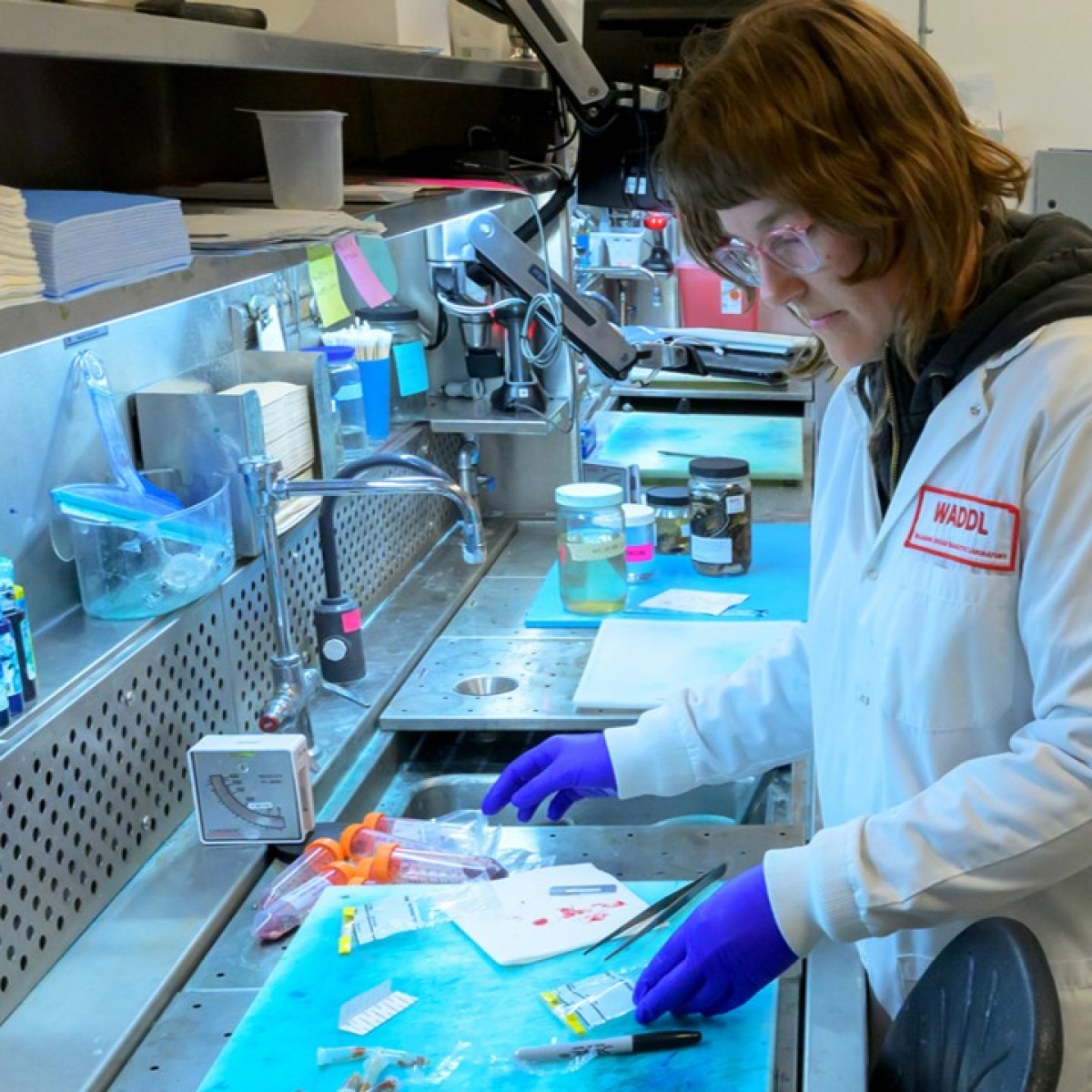
The trek to a remote lake in New Zealand begins before dawn for Nora Hickey, a veterinarian with Washington State University’s Washington Animal Disease Diagnostic Laboratory.
After sunrise, she and her colleagues begin collecting tissue samples from a handful of Chinook salmon caught in the frigid waters of Lake Heron, then pack them into a cooler bound for Pullman, Washington.
The samples must complete a nearly 8,000-mile journey through four airports within 48 hours to reach WADDL, one of the nation’s leading aquatic animal disease diagnostic laboratories housed in WSU’s College of Veterinary Medicine. There, staff will test them for 29 different pathogens, including viruses, bacteria, fungi, and parasites.
The work is part of a partnership between WSU and the Winnemem Wintu Tribe to bring Chinook salmon back to their ancestral lands along Northern California’s McCloud River, where the fish disappeared in the 1940s after Shasta Dam cut off access to their spawning grounds. The salmon being tested are descended from fish taken from the river and sent to New Zealand more than a century ago, a critical step in the tribe’s decades-long effort to restore the species and return it safely to California waters.
The current recovery plan involves three larger efforts — bringing eggs from the New Zealand fish back to California, constructing a fish passage around Shasta and Keswick dams, and habitat restoration within the McCloud River.
“In our creation story, the salmon were our guardians. They helped us when all the spirit beings left the mountain to take care of the earth. The salmon gave us their voice so we could communicate, because we needed a lot of help. That relationship with the salmon continues in every generation of Winnemem Wintu who carry that fire,” Winnemem Wintu Chief Caleen Sisk said. “If we are not successful in bringing the salmon back, everything suffers. Orcas are suffering. Bears are suffering. The salmon are the fate of the water. If the salmon are destroyed and not revived, no one is tending the riverbed. It’s important because the aquifers are all connected, and if they aren’t tended to, they get clogged up. If that happens, not just the Winnemem, but all people will feel that.”
In 2023, the Winnemem Wintu Tribe entered a co-management agreement with the California Department of Fish and Wildlife that formally recognizes the tribe as a partner in salmon restoration and gives it a direct role in guiding recovery efforts on the McCloud River.
The current recovery plan, known as the Winnemem Wintu Salmon Rematriation Project, involves three larger efforts, starting with bringing eggs from the New Zealand fish back to California. The second is constructing a fish passage around Shasta and Keswick dams, and the third focuses on habitat restoration within the McCloud River.
Before the salmon can be reintroduced in California, they must meet strict federal and state health requirements designed to prevent the introduction of pathogens. WADDL, approved by United States Department of Agriculture’s Animal and Plant Health Inspection Service to conduct diagnostic testing for export of aquaculture species, was identified by the state of California as the best choice laboratory to perform this testing.
“There isn’t a lab in California that can do this work,” Hickey said, “and there is no other public lab in the country that can perform the full suite of testing required for this project.”
In New Zealand, sampling begins before sunrise at five different sites with ceremonial prayers representing the tribes involved with the project, the Winnemem Wintu and Ngāi Tahu (the main Māori tribe in the South island of New Zealand).
“We perform a ceremony before we enter the river to acknowledge the waterways, the mountains and the ancestors of the tribes,” said Melanie Cheung, a member of Ngāti Rangitihi (Central North island Māori tribe) and a biologist helping to lead the project. “In the Māori ceremony, we’re calling the fish home — letting them know it’s time to return to their ancestral waters.”
Accompanied by a team member, the samples are flown on a small plane from a nearby airstrip to Christchurch, then on commercial flights to Auckland, San Francisco, Seattle and Spokane, before they are driven to Pullman.
“There wasn’t a single courier company in the world that could get the samples to the lab in time,” Cheung said, “so, we’ve had to hand deliver them.”
The project requires at least two consecutive years of pathogen testing to secure permits to import fertilized eggs, the safest life stage for transport. One year of testing has been completed.
Cheung is hopeful testing will wrap up this year, as rising water temperatures are causing Chinook salmon populations in New Zealand to collapse. From an estimated 10,000 wild fish just a few years ago, fewer than 1,200 may remain.
“We’re trying to get this across the line in 2026 because the fish are dying in New Zealand,” Cheung said. “What’s happening in California is happening there too. We feel incredibly lucky — and protected by our ancestors — that this project has made it as far as it has.”
Author: Devin Rokyta
Source: https://news.wsu.edu/
 Comments
Related Articles


More news

Copyright © 2026 - All Rights Reserved
ISSN 2768-198X
List
Add
Please enter a comment