

Professor Emerita of Diagnostic Imaging Dominique Penninck
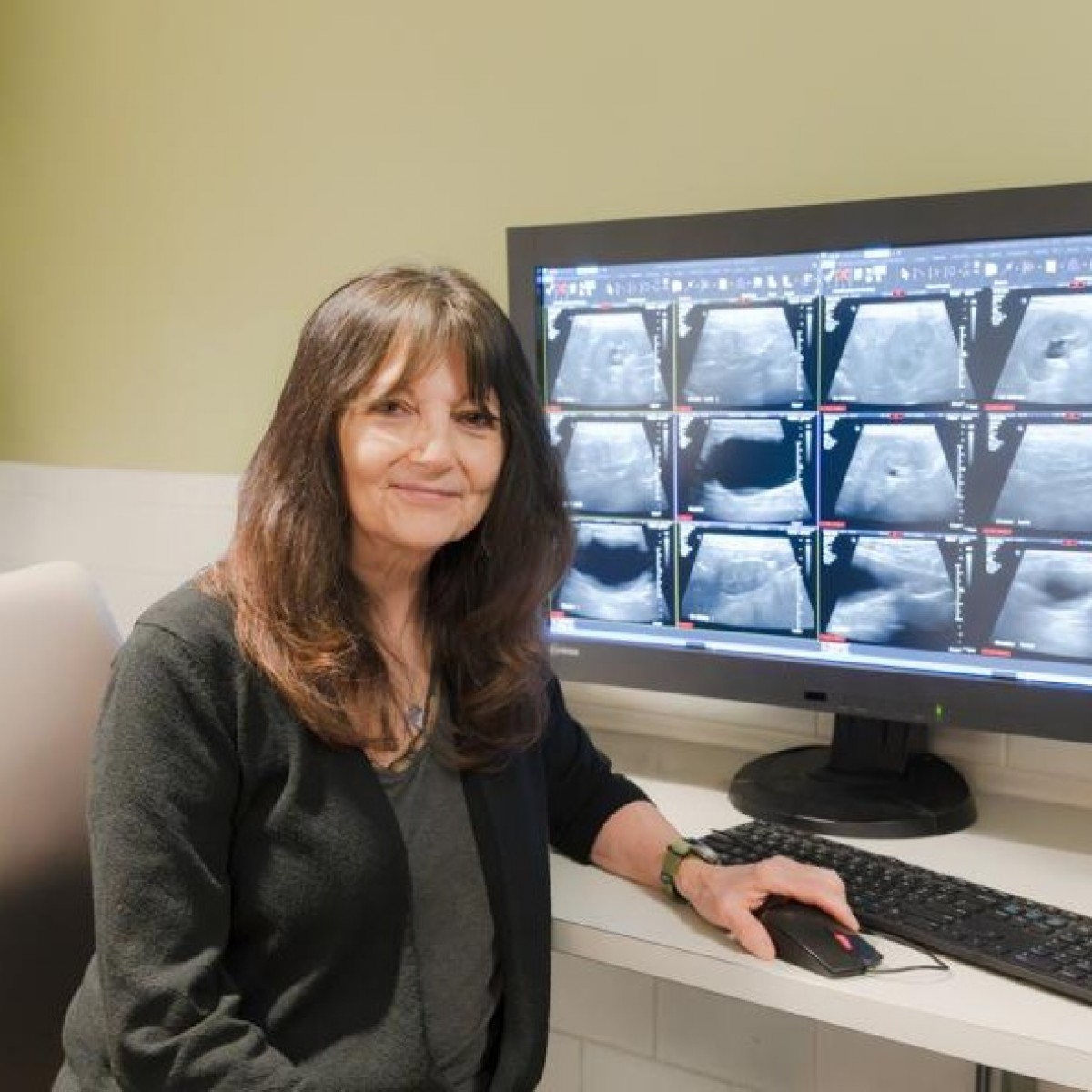
A prolific researcher, dedicated clinician, and leader at Cummings School of Veterinary Medicine at Tufts University, newly honored Professor Emerita of Diagnostic Imaging Dominique Penninck (she/her) continually explored new avenues in diagnostic imaging to raise the bar in patient diagnosis and treatment.
"It is definitely an honor,” Penninck says of earning the emerita professor title. “I still love what I do, and it gives me the chance to keep the link to the school and university that helped me be who I am today. I'm thankful and grateful for that. My lasting mission is spreading knowledge, and I like that I can still contribute on a different scale. Nothing is more motivating than seeing the light in these vets who are so eager to learn.”
Since 1989, Penninck has served patients at Hospital for Large Animals (HLA) and Henry and Lois Foster Hospital for Small Animals (FHSA). As professor of diagnostic imaging in the Departments of Large Animal Clinical Sciences and Small Animal Clinical Sciences, Penninck has drawn on deep expertise across all diagnostic imaging modalities, especially ultrasound, and interventional radiology to care for patients at both hospitals and to train veterinary students, interns, and residents. She is a diplomate of both the American College of Veterinary Radiology and the European College of Veterinary Diagnostic Imaging, serving as president of the latter for two years.
Penninck moved to the United States not speaking any English. She was born in Burundi, Africa, and grew up in Belgium. A television show about veterinarians caring for wild animals in Africa, called Daktari (Swahili for “doctor”), sparked an early interest in veterinary medicine that continued through her teen years, volunteering with a local veterinarian.
After earning her veterinary degree from the University of Liège in Belgium, Penninck trained in tropical medicine in Antwerp and considered a career treating wild animals in Africa. She ultimately decided to stay at the University of Liège as a small animal surgeon part-time while also working at a small animal private practice.
During her four years as a surgeon in Liège, Penninck started practicing ultrasound. Since veterinary ultrasound was a nascent field at the time, she connected with a pediatric radiologist at a nearby hospital who offered guidance, let her observe ultrasound techniques, and facilitated her access to an ultrasound machine. At times, Penninck practiced ultrasound on animal cadavers.
Her path included two months of consultancy at the University of Montréal’s Veterinary School of Saint Hyacinthe, where she provided guidance to the clinicians on how to start using ultrasound at the hospital.
Penninck switched her focus from surgery to radiology, securing residency in diagnostic imaging at the University of California, Davis. There, she not only learned all diagnostic imaging modalities in several species, but also developed her English skills.
“It was probably the best place to land because people were tremendously patient with my limited English,” she laughs. After residency, Penninck remained at UC Davis for an additional year as a lecturer, filling in for a faculty member on sabbatical.
For the next 37 years, Cummings School would be her home.
“When I arrived in 1989, the veterinary school was just starting. I liked it because if you had ideas, projects in mind, and the perseverance to accomplish them, everything was possible. I function better in an environment where there's a place for creativity and trying new endeavors,” she says of joining Cummings School’s faculty.
The Diagnostic Imaging service was already strong at FHSA and HLA, but the team was just beginning to use ultrasound.
“This was a great opportunity to grow that field, and we did,” says Penninck. “The applications in the field of clinical ultrasound expanded greatly. Similarly, at Cummings School, the same evolution happened progressively. Clinicians started to rely more and more on the modality. The fun and rewarding part has been expanding knowledge with my colleagues, not only radiologists, but internists and practitioners too.”
Ultrasound training is now part of internal medicine residency at Cummings School, and radiologists help promote and guide the training.
“Beyond abdomen, other applications such as thoracic, musculoskeletal ultrasound, and assisted interventional procedures were added, and the growth is exponential,” says Penninck. “At Cummings, we have a strong nephrology section in Internal Medicine, and we work as a team to assist them in their procedures and follow-ups of patients. I strongly believe in collaboration between different fields. That's how we all improve and advance.”
Penninck has contributed extensively to the clinical literature on abdominal ultrasound, particularly in relation to gastrointestinal (GI), pancreatic, and hepatobiliary diseases. She obtained her Ph.D. at the University of Liège, focusing on ultrasound of the GI tract. She is an editor of the Atlas of Small Animal Ultrasonography (most recently the third edition) and has written chapters for eight radiological textbooks. She has presented at imaging conferences across the United States, Europe, and South America.
Having lived in the United States for more than 40 years, Penninck always appreciated having colleagues at Cummings School from around the world. “I love that Cummings School has such an international flavor. This common trend of adapting to a new language and culture is unique and creates tightness amongst the members of the international community.”
What has kept Penninck at Cummings School since 1989?
“We play well together in the hospital, and the support between services is real. The attraction of an academic job, for me, is balancing education, clinical work, and research, supported by a healthy, collegial environment. The variety is key.”
Source: https://vet.tufts.edu/
 Comments
Related Articles





More news


Copyright © 2026 - All Rights Reserved
ISSN 2768-198X
List
Add
Please enter a comment