

Novel Procedure and Advanced Imaging Help Polo Pony Gelding Return to the Game
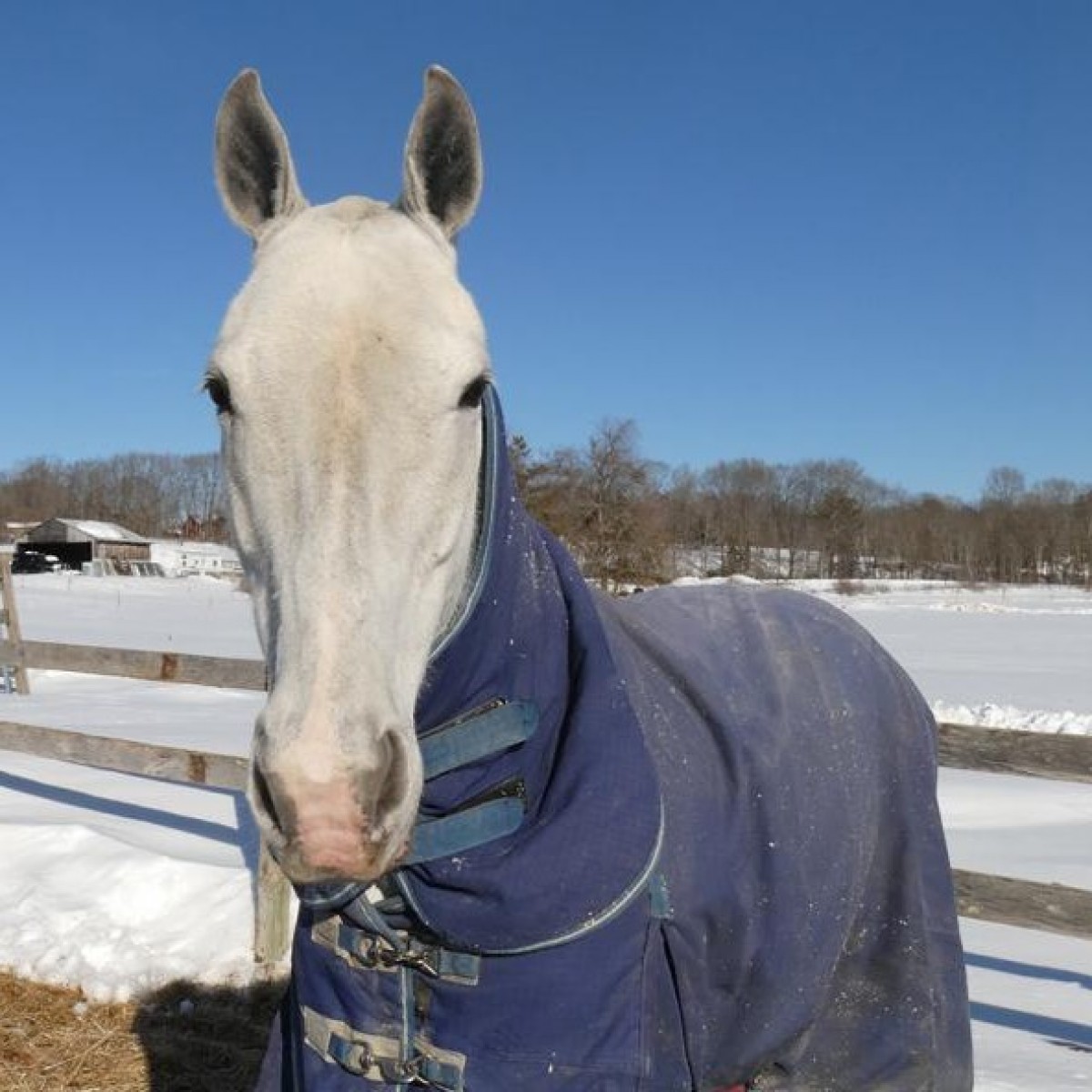
Sputnik immediately came up lame after tripping in polo practice. Finding the source of his hind limb lameness proved challenging and took several months. Using the most technologically advanced computed tomography (CT) scanner available, clinicians at Hospital for Large Animals (HLA) at Cummings School of Veterinary Medicine at Tufts University diagnosed the cause as a cyst in the horse’s fetlock joint, then removed the cyst, and used a new injectable bone adhesive combined with platelet-rich plasma to fill the defect.
An 11-year-old polo pony gelding originally from Argentina, Sputnik has led a decorated career with his polo partner, Emerson Bruce. Bruce started riding in middle school, and after her brother convinced her to try polo, she began training and playing year-round at Kingswood Polo Club in New Hampshire.
During her freshman year of high school, Bruce played with a few horses before clicking with Sputnik. They competed together throughout her high school years, including summers playing high-goal polo, the most elite level of the sport. Bruce captained the Kingswood women’s team before switching junior year to the mixed-gender team, winning the regional tournament three times and competing at the national championship twice, one year taking third place. With Sputnik as her partner, Bruce has won several All-Star and MVP accolades throughout these competitions.
“Sputnik is really into the game,” says Bruce. “You can tell when we're playing he knows where the ball is, he knows what his job is. He has a lively gait, whipping his tail. He's having fun.”
While chasing the ball during a practice game in January of last year, Sputnik tripped.
“He wasn't putting weight on his hind hoof, so I immediately dismounted,” Bruce recalls. “That first day when he tripped was very scary because we didn't know what it was. When a horse won't put weight on their leg, there are so many possibilities running through your mind.”
Their veterinarian suspected Sputnik had a small fracture in his left hock on X-ray. The fracture was allowed to heal over the next several months, but Sputnik’s lameness persisted.
Bruce and her mother brought Sputnik to HLA last September. Dr. Joe Davis, large animal surgeon at HLA and assistant clinical professor in the Department of Large Animal Clinical Sciences at Cummings School, first tried to localize the source of Sputnik’s pain using nerve blocks, but without success. He suspected a suspensory ligament injury, but diagnostics showed that was not the cause.
Davis next recommended a bone scan. During a bone scan, patients are given a low-dose radioactive isotope that illuminates the skeleton to show areas of inflammation. Davis saw an area of high uptake of the radioactive isotope in Sputnik’s fetlock joint (located on the lower leg, between the cannon bone and pastern).
The team conducted a CT of Sputnik’s fetlock joint using HLA’s Qalibra™ CT system, the only scanner of its kind in New England. It provides high-resolution imaging and an enlarged bore size for scanning areas of larger animals. Many areas of the horse can be scanned standing, eliminating the need for anesthesia. The scanner’s mobile platform enables clinicians to scan a horse’s head and neck, and can be lowered to the floor to scan the lower limbs. Sputnik simply picked up his leg and placed it on the CT table for the scan.
After the initial CT of the fetlock, the team performed a second CT with contrast in the joint to determine if Sputnik had damage to his cartilage. The CT showed that the cartilage had a small defect overlying a cyst that had formed in the bone above the fetlock joint, pinpointing the source of Sputnik’s lameness. Cysts are most commonly found in the stifle joint and rarely in the fetlock joints of non-racing horses.
“It was a lameness we couldn't quite identify with our traditional methods,” says Davis. “The bone scan localized it to the fetlock joint, and then the CT confirmed our diagnosis and helped with the surgical planning. He was a good candidate to go in, clean it out, and repair it because the rest of the joint appeared healthy. He could have a very good outcome.”
Davis explains that radiographs from X-rays can’t provide the same level of clarity and detail as the CT scanner. Based on the scans, Davis could assess the condition of Sputnik’s cartilage and bone before performing surgery. In hopes of giving the horse the best chance possible to recover and return to playing, Davis considered a newer method of treatment.
A recently introduced bone substitute that is a self-setting calcium phosphate-based bioadhesive paste was used to fill the hole in a bone caused by the cyst.
Davis and team performed arthroscopy, inserting a scope affixed with a camera through a small incision in Sputnik’s leg to visualize the fetlock joint. Through a second small incision, Davis cleared out the cyst in the joint. Traditionally, bone replacement granules are placed into the cavity after a cyst is removed. Instead, Davis used the OssiVet® to inject self-setting bone substitute to replace the missing bone where the cyst had been. Platelet-rich plasma (PRP) was collected from the horse and combined with fibrin to make an adhesive clot to seal the surface of the repaired bone cyst. PRP contains growth factors that promote healing of the joint surface, while the bone substitute heals the cyst.
“We’re constantly doing new procedures and getting new equipment—trying it, using it, and seeing how we like it,” says Davis. On the new bone replacement device, he says. “It's something to use on these types of cases. It has some other applications, but on cysts like this where you're trying to fill in with bone replacement, it's easy to inject into the defect, and it sets up hard, like an epoxy, so it works very nicely.”
Sputnik recovered from the surgery at HLA and returned to Kingswood Polo Club the following day, where he has been attentively cared for during his healing process. He has since started trotting again and can flex the joint.
“The goal is for him to go back and play polo again, even if not at the highest level,” says Davis. “We know the cartilage isn't perfect where that hole was, but if that leg is sound, and he can go play again, then that's a good outcome for me.”
Bruce now plays on the Georgetown University polo team as a freshman. She plans to play with Sputnik again in her club league this summer.
“When I've gone home to visit him, he'll be playing in the water with another horse also on injured leave, and they’ll just be splashing,” says Bruce. “I'm very excited for him to be recovered and able to play again. He loves polo, so if he can play it at a slower pace, I'd love for him to be able to do that.”
Source: https://vet.tufts.edu/
 Comments
Related Articles

More news



Copyright © 2026 - All Rights Reserved
ISSN 2768-198X
List
Add
Please enter a comment