

Award-Winning Show Sheep Recovers from Grain Overload
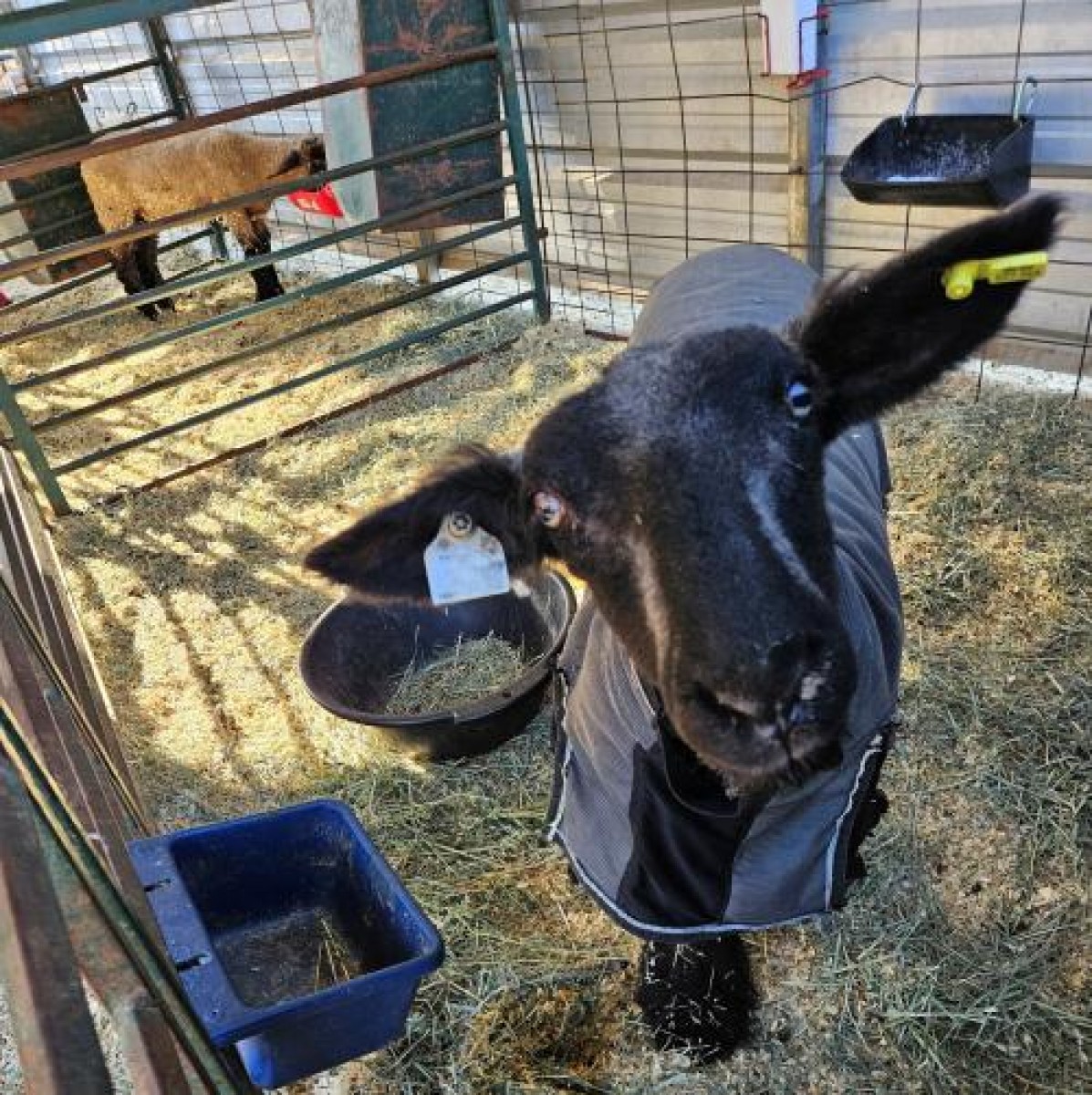
At 9 months old, Onyx is already an experienced show animal. His family has been showing sheep as a hobby for nearly a decade, and Onyx is the latest addition to their flock. Unfortunately, the award-winning Natural colored Hampshire cross sheep became acutely ill at a recent show.
“After traveling to a show, I could tell Onyx wasn’t feeling well that evening, but I wasn’t terribly worried,” said his owner. “But on a walk the next morning, he went down abruptly and could not get back up.”
The show’s onsite veterinarian thought there might be a urinary blockage but realized after treatment that was not the issue. The veterinarian administered thiamine (vitamin B1) and a trusted non-steroidal anti-inflammatory drug commonly used to treat pain in livestock. The family was then advised to take Onyx to UC Davis immediately. To save time, they loaded their prized sheep into the back seat of their truck and drove the three hours to Davis with Onyx as a passenger.
When Onyx arrived at the UC Davis William R. Pritchard Veterinary Medical Teaching Hospital, he was unable to get up, had stiffness of the hind limbs, was abnormally dull, and had additional signs of neurologic disease including seizure activity. The Livestock Medicine and Surgery Service began emergency treatment including IV fluid therapy and anti-seizure medication and initiated diagnostic tests: his bloodwork was within reference ranges; an ultrasound and radiographs of his abdomen ruled out any urinary obstruction; but a sample of his rumen showed abnormally low pH levels, indicative of rumen acidosis, or grain overload.
“The UC Davis team was fabulous from the very beginning,” Onyx’s owner stated. “We called beforehand, and they met us immediately upon our arrival. Within just 45 minutes, we were consulting with the veterinarians, and they already had a handle on the situation and had developed a treatment plan.”
Rumen acidosis is a metabolic disease in ruminants—herbivores with four-chambered stomachs (cattle, goats, sheep, deer, etc.)—caused by the rapid fermentation of large amounts of starchy feed, like grains, in their rumen. This leads to a drop in rumen pH, causing damage to the rumen microbes, rumen wall, and sometimes leads to severe systemic complications such as acidosis and bacterial spread into the blood or other organs.
The day before Onyx went down, his diet was altered slightly. Some ruminants are more sensitive to diet changes than others, and this change may have caused the acidosis, which kills off the rumen bacteria that synthesize the thiamine that ruminants need to survive. When the rumen is not functioning properly, the animal can quickly become thiamine deficient. Thiamine is required for maintaining adequate energy levels in the brain. Low thiamine can lead to polioencephalomalacia (PEM), also known as “polio” in ruminants, which is a metabolic disease of the brain that can lead to death in severe cases (different from poliomyelitis in humans); this was most likely the cause Onyx’s neurological problems. PEM is a painful condition that can cause animals to become blind, have seizures, or be down.
Onyx was treated with thiamine supplementation to treat signs of PEM. He was also given magnesium hydroxide to correct the rumen pH, antibiotics to prevent spread of bacteria to his blood from his damaged rumen, and fluid therapy to manage hydration, as well as IV energy supplementation while he healed. He was also transfaunated with rumen juice from an onsite donor animal to re-populate his rumen with healthy microbes. He clinically improved relatively quickly – his mentation went back to normal, and he was able to stand up on his own after 24 hours of treatment (48 hours total since he initially went down).
After being hospitalized for four days, Onyx returned home. His owner reports that he has recovered almost 100% neurologically and is eating well, especially enjoying the unlimited hay offering. Onyx’s owners are working hard to help him recover from muscle stiffness and put weight back on him. While still 10 pounds underweight since becoming sick, Onyx is regaining the weight slowly, and his family’s goal is to have him back in the show ring by October.
Auhtor: Rob Warren
Source: https://www.vetmed.ucdavis.edu/
 Comments
Related Articles





Copyright © 2026 - All Rights Reserved
ISSN 2768-198X
List
Add
Please enter a comment