

Two TVFS Vets and Two Fire Departments Rescue Horse Stuck in a Bog
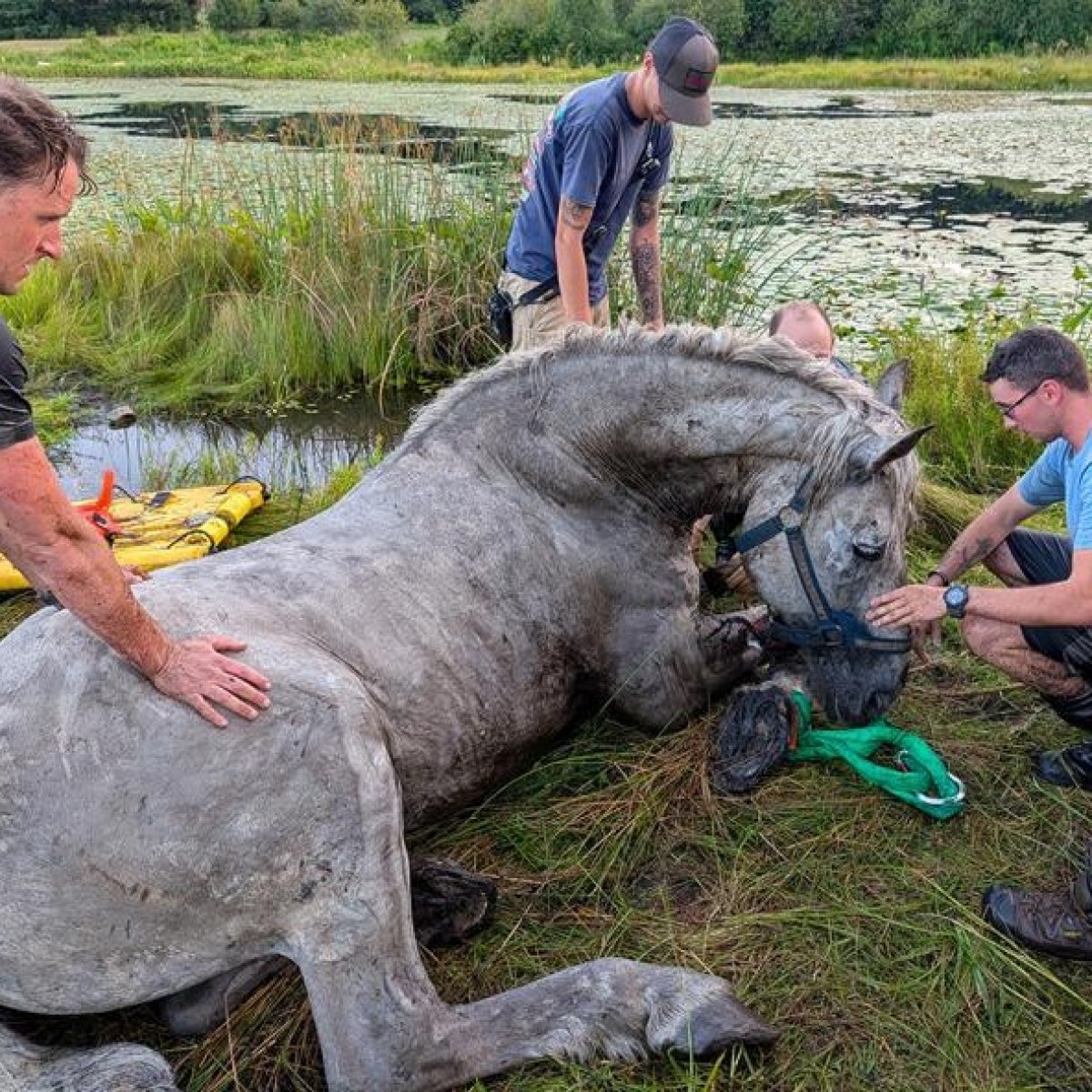
When a Percheron draft mare named Snowflake broke through a fence along her pasture and became trapped in a bog, the veterinarians on call at Tufts Veterinary Field Service (TVFS) at Cummings School of Veterinary Medicine joined forces with more than 20 firefighters from two towns to save her. With the assistance of two TVFS trucks, three firetrucks, an ambulance, specialized large animal rescue equipment, spotlights, and an all-terrain vehicle, the vets and firefighters relied on each other’s expertise to safely extract the horse without injury.
Snowflake worked most of her life as a plow horse for an Amish family in Pennsylvania. Several years ago, an animal rescue organization bought her at auction. Carol Mead, who owns a 30-acre farm in Thompson, Connecticut, adopted Snowflake from the rescue.
“I bought her so she would have a life without work, to live out her life here,” says Mead.
One evening last summer, Mead could not find Snowflake in her pasture. Looking through binoculars from a second-story window, she spotted the tips of Snowflake’s ears peeking through the reeds down in a boggy channel adjacent to a pond on her property.
“I called Tufts [Tufts Veterinary Field Service ] immediately,” Mead says.
TVFS veterinarians provide 24/7 emergency care for animals within their service area, which spans parts of Connecticut, Massachusetts, and Rhode Island. The large animal veterinary practice treats patients for primary and emergency care on the farm and on-site at the haul-in clinic in Woodstock, Connecticut.
On call at TVFS that evening were Dr. Robert Dwyer, assistant clinical professor, and Dr. Hayley Lindsey, intern in Large Animal Ambulatory Medicine, both in the Department of Large Animal Clinical Sciences at Cummings School. A typical emergency call at TVFS can range from a horse with a laceration to a cow needing assistance giving birth.
“It was one pretty unusual emergency call,” says Dwyer, who previously rescued a horse from a deep ditch on the side of a road in England with the help of firefighters, a farmer, and a tractor forklift.
When Dwyer and Lindsey arrived on scene, they found Snowflake standing in the middle of the bog immobilized, with her hoofprints tracked all over the swampy area.
“Horses getting stuck is not relatively common; I’ve seen two or three in my career,” says Dwyer. “This was the worst by far. We needed to call for the fire department—it was going to be a big job.”
The vets made their way through thick, muddy brush to the channel, testing the ground with sticks before stepping to avoid sinking themselves.
“It was treacherous to get to the horse, let alone figure out how we were going to attach our equipment,” says Lindsey. “The horse was shoulder-deep in the mud and water.”
They waded into the bog, coming up alongside Snowflake. She was exhausted and dehydrated, but otherwise calm when they examined her. Her hooves were sunk deep into the mud.
“We had to pick a starting point and problem-solve from there,” says Dwyer. “The general plan was to get an idea of what her capacity was, if she might have the strength to walk out.”
The vets attached a halter around her head and straps behind her thighs. They pulled on the straps and encouraged her to stand. She gave a modicum of effort, then sank back down in the mud.
The Quinebaug [Connecticut] Volunteer Fire Department arrived and called in the Pomfret Fire Department with the equipment to lift large animals. The access road was about 500 yards from the horse, across muddy, unpredictable ground that drops steeply into the channel. The vets and firefighters discussed the choice of equipment to extract Snowflake. They first tried a forklift tractor, but the ground was too boggy.
“We improvised with a lot of ropes and pulleys because the usual equipment couldn’t make it over the terrain,” says Dwyer. “Usually, the thing to do would be to put wide straps around the chest and lower abdominal region to lift the horse up in the air safely, but she was so well wedged in, there was zero possibility of getting anything under the horse.”
A Pomfret firefighter drove a four-wheeler all-terrain vehicle (ATV) as close as he could on dry land. Dwyer and Lindsey placed a large strap underneath the horse’s tail and around the hindquarters, attached to pulleys and ropes that the firefighters secured to a winch on the front of the ATV. A rope halter and lead-rope were also used to pull Snowflake forward and keep her head above the water. With the ATV anchored by a rope to a tree behind it, the firefighter operated the ATV winch in short bursts while firefighters pulled on ropes from the water.
“We had multiple ropes attached to her legs, having to be pulled equally, so as not to injure the horse and also get her moving, because not only was she a horse, but a very large horse, upwards of 1,500 pounds,” says Lindsey.
Dwyer and Lindsey closely monitored Snowflake’s legs. As they created movement, her hooves would catch in the mud, bending her legs, and the vets would yell out to the firefighters to stop.
“Every few minutes, every few pulls, we had to remove her feet from getting stuck in the mud because they would just sink right back down into it,” says Lindsey.
“It was quite tricky and nerve-wracking because if we lifted too fast, that horse’s leg would get stuck and fractured. That would be a fatal complication. We had to do really small movements and readjust and go again,” adds Dwyer.
As they inched ahead, the channel deepened, and Snowflake’s head suddenly dunked under. Dwyer jumped forward to lift her head and prevent her from drowning. The firefighters provided a floating stretcher to place underneath her chin. Her head flopped sideways into the water, so the vets continually repositioned her head and legs throughout the rescue.
“The best thing she did to help herself is that she didn't struggle,” says Lindsey. “It allowed us to move her without her resisting in any sort of way.”
Observing the rescue, Mead recalls, “Snowflake did everything the vets asked her to do. She’s a gentle giant. She was bred and taught to work.”
The vets and firefighters were able to pull Snowflake up onto a bank after an hour of actively pulling her out of the bog. She lay on her side, too weak to stand. Dwyer and Lindsey attached straps around each of her legs individually (a technique used in equine surgeries) to pull her up the swampy hillside with the ATV.
As darkness fell, the firefighters set up spotlights. With dusk also came voracious mosquitoes, and also wasps after the ATV hit a nest. Several of the firefighters were badly stung, and an ambulance arrived to treat them.
Once Snowflake was on the top of the bank, the firefighters helped prop her up on her stomach, while Dwyer and Lindsey fed her hay and administered IV fluids for hydration, and pain and anti-inflammatory medications.
After an hour of rest and nourishment, Snowflake gained the strength to stand. Dwyer and Lindsey walked her back to her paddock, safe and sound.
“It was a really good team effort, everyone was well aligned and really engaged,” says Dwyer. “Dr. Lindsey did great. It’s a pretty major thing to do, having just graduated from vet school.”
“We had a lecture on horse emergency situations, breaking through ice or getting stuck, but it's very different in real life when you're faced with the reality of a situation and the challenges that come with it,” says Lindsey. “Something unique to our field as large animal vets is that we are regularly treating animals on people's properties or in areas we haven't been before, without the stability of a clinic or a controlled environment. We show up to calls with the mental preparation that we might need to think outside the box.”
Lindsey and Dwyer are grateful for the firefighters’ expertise, manpower, and support throughout the rescue.
“The firefighters brought a lot of experience and wisdom to the table,” says Lindsey. “Having a variety of perspectives to troubleshoot and that support system—grabbing more ropes, bringing us water bottles, as it got dark putting out those big spotlights—was really helpful. It was a collaborative effort and just an incredible situation to look back at.”
Mead was touched by the vets’ and firefighters’ dedication to getting Snowflake to safety. “It was a miracle that all those people helped. It was wonderful.”
Dwyer has visited Snowflake a few times since the incident and reports she is fully recovered.
“It’s hard work being on call,” says Dwyer with a chuckle. “The veterinarians and support team at the Field Service do a great job serving clients and the large animal community in this part of New England—the commitment to the community is outstanding.”
Source: https://vet.tufts.edu/
 Comments
Related Articles


More news


Copyright © 2026 - All Rights Reserved
ISSN 2768-198X
List
Add
Please enter a comment